This paper seeks to compare and contrast the differences in the way manufacturing firms and service firms operate. For this purpose the paper conducts a comparative analysis of the operations strategy of Toyota, the world’s leading car manufacturer and Ryanair, Europe’s leading low-cost airline. Firstly, it will be dealt with the competitive factors both companies need to excel at in order to gain competitive edge and sustain economic viability from a long-term perspective. Secondly, it will outline the major aspects that enable both companies to succeed in a highly competitive and dynamic business environment. In particular, it will draw on key components of successful operations strategies, such as process design, human resource management, innovation management, supply chain management and quality management. Finally, the paper concludes by summing up the key points and highlighting the respective implications. In addition, the paper provides a more comprehensive strategic analysis of Ryanair’s low-cost strategy in the appendix in order to promote understanding.
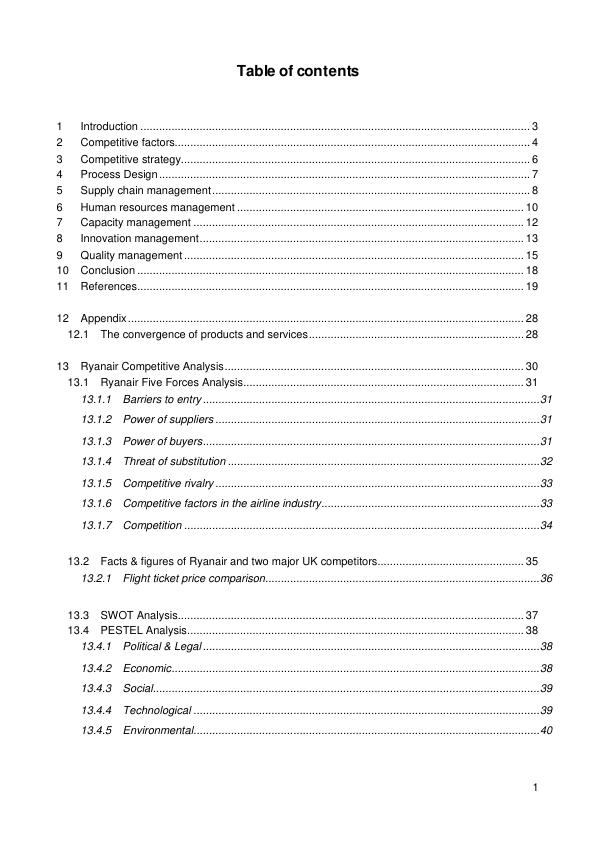
Table of Contents
1 Introduction
2 Competitive factors
3 Competitive strategy
4 Process Design
5 Supply chain management
6 Human resources management
7 Capacity management
8 Innovation management
9 Quality management
10 Conclusion
11 References
12 Appendix
12.1 The convergence of products and services
13 Ryanair Competitive Analysis
13.1 Ryanair Five Forces Analysis
13.1.1 Barriers to entry
13.1.2 Power of suppliers
13.1.3 Power of buyers
13.1.4 Threat of substitution
13.1.5 Competitive rivalry
13.1.6 Competitive factors in the airline industry
13.1.7 Competition
13.2 Facts & figures of Ryanair and two major UK competitors
13.2.1 Flight ticket price comparison
13.3 SWOT Analysis
13.4 PESTEL Analysis
13.4.1 Political & Legal
13.4.2 Economic
13.4.3 Social
13.4.4 Technological
13.4.5 Environmental
13.5 Ryanair’s Strategic Capabilities
13.5.1 Physical Resources
13.5.2 Human Resources
13.5.3 Core Competences
13.6 Value Chain Analysis
13.7 Asset/Resource Analysis
13.8 How Ryanair adds value and differentiates itself from competitors
13.9 Industry Life Cycle / BCG Growth-Share Matrix
14 Conclusion
15 Recommendations on Ryanair’s future direction
15.1 Michael Porter’s Generic Strategies / Bowman’s Strategic Clock
15.2 ANSOFF Matrix
15.3 Strategic human resources and CSR
15.4 Lean thinking
15.5 Diversification
16 References - Ryanair Strategic Analysis
Objectives & Core Topics
This study conducts a comparative operations strategy analysis between Toyota, a global manufacturing leader, and Ryanair, a prominent low-cost service airline. The research explores how these diverse organizations optimize their operations, manage supply chains, foster innovation, and maintain quality to gain a competitive edge.
- Comparative analysis of operational strategies in manufacturing vs. service sectors.
- Evaluation of "Toyota Way" production principles and Ryanair’s low-cost business model.
- Application of strategic frameworks including Porter's Five Forces, SWOT, and PESTEL.
- Investigation into capacity management, human resource policies, and innovation management.
- Strategic recommendations for Ryanair’s future growth and diversification.
Excerpt from the Book
1 Introduction
This paper seeks to compare and contrast the differences in the way manufacturing firms and service firms operate. For this purpose the paper conducts a comparative analysis of the operations strategy of Toyota, the world’s leading car manufacturer and Ryanair, Europe’s leading low-cost airline. Firstly, it will be dealt with the competitive factors both companies need to excel at in order to gain competitive edge and sustain economic viability from a long-term perspective.
Secondly, it will outline the major aspects that enable both companies to succeed in a highly competitive and dynamic business environment. In particular, it will draw on key components of successful operations strategies, such as process design, human resource management, innovation management, supply chain management and quality management. Finally, the paper concludes by summing up the key points and highlighting the respective implications. In addition, the paper provides a more comprehensive strategic analysis of Ryanair’s low-cost strategy in the appendix in order to promote understanding.
Summary of Chapters
1 Introduction: Provides an overview of the comparative research goals between Toyota and Ryanair and outlines the scope of the operations strategy analysis.
2 Competitive factors: Defines key success factors for both companies, contrasting manufacturing requirements like quality and dependability with service-based winners like price.
3 Competitive strategy: Analyzes the market positioning of both firms using Bowman’s strategic clock to demonstrate performance trade-offs.
4 Process Design: Examines Toyota’s lean manufacturing and JIT systems against Ryanair’s process automation and service disintermediation.
5 Supply chain management: Compares Toyota’s long-term supplier relationship model with Ryanair’s reliance on aircraft makers, airports, and fuel markets.
6 Human resources management: Contrasts Toyota’s investment in staff development and retention culture with Ryanair’s performance-based pay and cost-minimization approach.
7 Capacity management: Explores techniques for balancing supply and demand, highlighting Ryanair’s yield management and Toyota’s production control systems.
8 Innovation management: Discusses the differences between Toyota’s bottom-up "kaizen" approach and Ryanair’s top-down, technology-driven innovation.
9 Quality management: Details how both companies maintain safety and reliability, contrasting Toyota’s standardized production lines with Ryanair’s quality execution in air travel.
10 Conclusion: Synthesizes the core operational findings and emphasizes that long-term success relies on holistic systems rather than single activities.
Keywords
Operations Strategy, Toyota Production System, Ryanair, Low-Cost Airline, Competitive Advantage, Process Design, Supply Chain Management, Lean Manufacturing, Quality Management, Strategic Management, Porter’s Five Forces, PESTEL, Yield Management, Human Resource Management, Innovation
Frequently Asked Questions
What is the core focus of this research?
The paper examines and compares the operational strategies of Toyota, a leading manufacturer, and Ryanair, a low-cost service provider, to identify how both firms achieve and sustain competitive advantage.
What are the primary thematic fields covered?
The study covers process design, supply chain coordination, human resource management, capacity management, innovation strategy, and quality assurance within these two specific industries.
What is the main objective of the analysis?
The primary goal is to determine how different types of firms—manufacturing vs. service—tailor their operations to remain viable and successful in dynamic, highly competitive global markets.
Which scientific methods are employed?
The research utilizes comparative analysis and standard strategic management frameworks, including Porter’s Five Forces, SWOT, PESTEL, and the Ansoff Matrix.
What does the main body of the work address?
The main chapters provide a detailed investigation into specific operational pillars, such as how Toyota’s lean techniques compare to Ryanair's service-based cost-cutting strategies.
Which keywords best characterize this work?
The work is defined by terms like operational efficiency, lean manufacturing, cost leadership, strategic capabilities, and competitive differentiation.
How does Ryanair manage its capacity constraints?
Ryanair utilizes sophisticated yield management techniques, adjusting ticket prices dynamically based on forecasted demand, and emphasizes high aircraft utilization through rapid turnaround times.
What is the critique regarding Ryanair's HR strategy?
The paper notes that while Ryanair's frugal HR approach drives operational cost savings, it creates challenges regarding employee commitment and potential long-term risks to culture and brand image.
- Quote paper
- BA (Hons) Christoph Müller (Author), 2011, Case study and comparative strategic analysis of Toyota and Ryanair, Munich, GRIN Verlag, https://www.hausarbeiten.de/document/170671