This essay deals with postmodernism and its different realizations of the term in literature and about one of the most recognizable authors of this period, Salman Rushdie. First of all, we would like to give a brief overview of the history of postmodernism, whereas we see that it is rather difficult to find a clear and satisfying definition of this expression. We try to name and shortly explain the main features of postmodern literature and to inform the reader about some of the most typical authors of this period. In the second part of this essay we want to clarify the referred attributes of postmodernism with the example of Salman Rushdie whose book Shame, or at least some passages of it, will be part of a closer analysis.
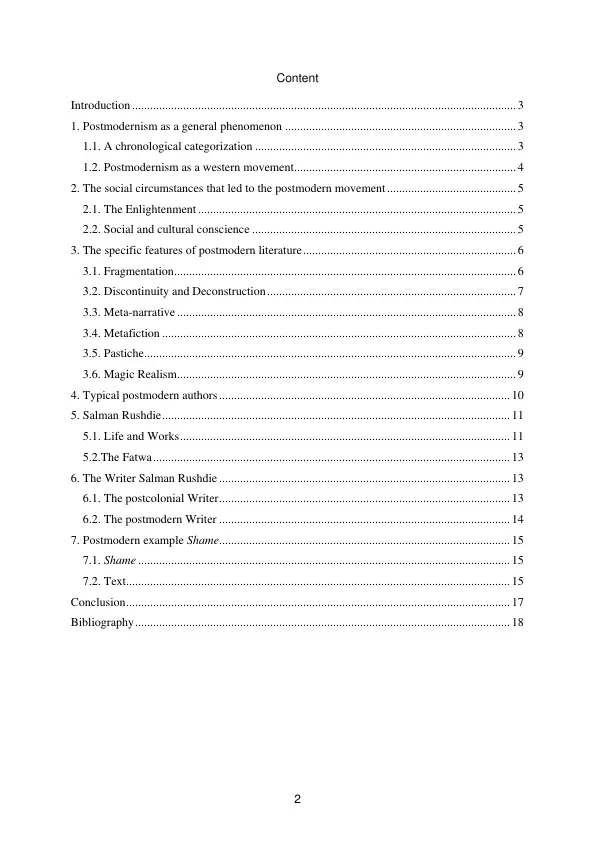
Table of Contents
Introduction
1. Postmodernism as a general phenomenon
1.1. A chronological categorization
1.2. Postmodernism as a western movement
2. The social circumstances that led to the postmodern movement
2.1. The Enlightenment
2.2. Social and cultural conscience
3. The specific features of postmodern literature
3.1. Fragmentation
3.2. Discontinuity and Deconstruction
3.3. Meta-narrative
3.4. Metafiction
3.5. Pastiche
3.6. Magic Realism
4. Typical postmodern authors
5. Salman Rushdie
5.1. Life and Works
5.2.The Fatwa
6. The Writer Salman Rushdie
6.1. The postcolonial Writer
6.2. The postmodern Writer
7. Postmodern example Shame
7.1. Shame
7.2. Text
Objectives and Topics
This essay examines the historical, social, and literary dimensions of postmodernism, specifically focusing on its manifestation in literature and its thematic application in the works of Salman Rushdie. It explores the transition from modernist certainty to postmodern fragmentation and analyzes how these theoretical shifts inform literary narratives.
- The historical emergence and defining characteristics of postmodernism.
- The sociopolitical impact of Enlightenment ideals and their subsequent subversion.
- Specific literary techniques such as metafiction, pastiche, and magic realism.
- The biographical and literary career of Salman Rushdie within a postcolonial and postmodern context.
- A detailed analysis of Rushdie's novel Shame as an example of postmodern stylistic complexity.
Excerpt from the Book
7.2. Text
In this scene the author blurs the barriers of time. It is in the tradition of post-modern writers to cross all borders even of time and place, and moreover reality and fiction. At this point of the story we are being introduced to the main protagonist Omar Khajjam Shakil and are informed about his origin. Within this characterisation, Shakil is being compared to his future wife Sufiya Zinobia. And the reader has the ability to have a slight first impression of the second main protagonist :
(...) she, foolish Sufiya Zinobia, would lie in bed squeezing her eyes shut between her thumbs and forefingers, as if she could extrude consciousness through her eyelashes, like motes of dust, or tears. And she burned, she fried, in that very room of her husband's birth and his grandfather's death beside that bed of snakes and Paradise. . . . a plague on this disobedient Time! I command this death scene back into the wings at once: Shazam!
Summary of Chapters
Introduction: Outlines the scope of the essay regarding postmodernism in literature and the selection of Salman Rushdie as a primary author for analysis.
1. Postmodernism as a general phenomenon: Discusses the difficulty in defining postmodernism and its role as a radical break from modernism and structuralism.
1.1. A chronological categorization: Traces the origins of postmodernism to the 1960s and 1970s, linking it to the disillusionment with Enlightenment science.
1.2. Postmodernism as a western movement: Examines the cultural ubiquity of postmodernism in the West and its intersections with various political movements.
2. The social circumstances that led to the postmodern movement: Analyzes the sociological underpinnings of modernism and the Enlightenment's focus on reason and order.
2.1. The Enlightenment: Explores the pillars of modernism: reason over ignorance, order over disorder, and science over superstition.
2.2. Social and cultural conscience: Discusses the shift in consciousness following World War II, nuclear threats, and the rise of globalization.
3. The specific features of postmodern literature: Details the artistic qualities of postmodernism, including irony, fluid perspectives, and the reversal of roles.
3.1. Fragmentation: Explores how societal pluralism and the dominance of technology lead to fragmented literary structures.
3.2. Discontinuity and Deconstruction: Discusses the destabilization of language and the rejection of universal truths in favor of provisional local narratives.
3.3. Meta-narrative: Defines meta-narrative as the postmodern parody of master-codes and traditional storytelling conventions.
3.4. Metafiction: Examines how postmodern authors use metafiction to break the illusion of realism and comment on the construction of the text itself.
3.5. Pastiche: Defines pastiche as a neutral, blank parody that reflects the cultural expression of late capitalist development.
3.6. Magic Realism: Analyzes the literary fusion of realistic and magical elements to disrupt conventional Western epistemologies.
4. Typical postmodern authors: Surveys influential figures like Jean Baudrillard, John Barth, and Thomas Pynchon who exemplify postmodern skepticism.
5. Salman Rushdie: Provides a biographical overview of the life and key literary works of Salman Rushdie.
5.1. Life and Works: Chronicles Rushdie's education, his early novels, and his critical success in the literary world.
5.2.The Fatwa: Discusses the controversy surrounding The Satanic Verses and the subsequent fatwa issued against the author.
6. The Writer Salman Rushdie: Explores Rushdie's identity and stylistic influences as a writer.
6.1. The postcolonial Writer: Analyzes how Rushdie's bicultural background and postcolonial themes shape his novels.
6.2. The postmodern Writer: Discusses Rushdie's affinity with magical realism and his ability to traverse the boundaries of fact and fiction.
7. Postmodern example Shame: Introduces the analysis of Shame as a case study for postmodern devices.
7.1. Shame: Examines the novel's themes of suppressed individuality, religious oppression, and its role as an allegory for Pakistan.
7.2. Text: Provides a close reading of specific passages in Shame to illustrate postmodern stylistic techniques.
Keywords
Postmodernism, Literature, Salman Rushdie, Metafiction, Magic Realism, Fragmentation, Deconstruction, Postcolonialism, Enlightenment, Shame, Identity, Narrative, Meta-narrative, Pastiche, Discontinuity.
Frequently Asked Questions
What is the primary focus of this essay?
The essay explores the conceptual and historical foundations of postmodernism in literature and applies these theories to the analysis of Salman Rushdie’s works.
What are the core themes addressed in the text?
The core themes include the rejection of grand narratives, the role of fragmentation and irony in postmodern literature, the impact of the Enlightenment on modern thought, and the synthesis of postcolonial and postmodern perspectives.
What is the central research objective?
The goal is to explain the diverse facets of postmodernism and clarify these attributes through a detailed textual analysis of Salman Rushdie’s novel, Shame.
Which scientific methods are employed?
The essay utilizes literary criticism, sociological inquiry into the origins of postmodernism, and close reading techniques to interpret narrative structure and metaphorical content.
What does the main body of the work cover?
The main body covers the definition of postmodernism, its relationship to the Enlightenment, specific literary features (like pastiche and metafiction), an author profile of Salman Rushdie, and a case study of Shame.
Which keywords best describe this work?
Key terms include Postmodernism, Metafiction, Magic Realism, Postcolonialism, Fragmentation, and the specific literary techniques utilized by Salman Rushdie.
How does the author define the relationship between religion and shame in Rushdie's work?
The text argues that Rushdie links shame directly to religious dogma, portraying it as a tool for political and social control that suppresses individuality and leads to destructive outcomes.
What significance does the term 'Shazam' have within the analysis of 'Shame'?
The text highlights 'Shazam' as an example of Rushdie's use of the absurd and authorial intrusion, noting its phonetic resemblance to the Urdu word 'Sharam' (shame), thereby reinforcing the thematic focus on religious oppression.
- Quote paper
- Myriam Christ (Author), 2004, Postmodernism and Salman Rushdie, Munich, GRIN Verlag, https://www.hausarbeiten.de/document/154366