The manifold reflections of loss of home or migration are complex in the displacement histories and narratives because they contain difficult, untraceable journeys and experiences of immigrants and refugees involved. At present, this also concerns the largest religious community linked to massive migration movements worldwide – the Muslims. All Muslim immigrants coming to Europe, Canada or the United States carry their national, cultural, religious and above all their personal past which taken together create an ideal basis for narrating their stories.
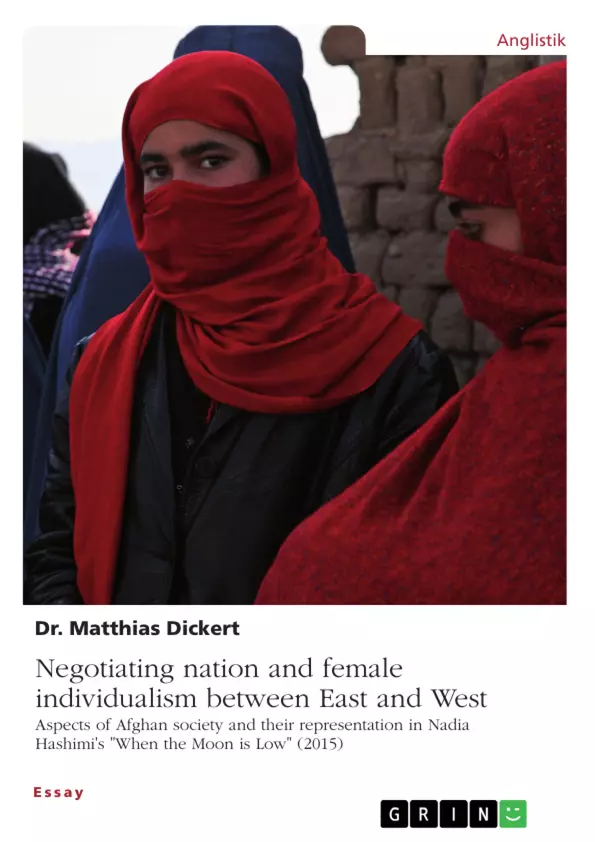
Things are worse in their own way when people at present are trying to flee from Afghanistan since the Taliban came back to power in 2021. Most Afghan people trying to escape from their mothercountry carry classical colonial or postcolonial topics such as matters of loss, expulsion, displacement, border crossing, exile, diaspora and home. These are – as in the case with female characters – often linked to intolerance, gender injustice or the inferior role of women in the Muslim world, which at present can be seen in Iran as well.
Nadia Hashemi’s novel “When the Moon is Low” (2015) is set against this background and offers an impressive story of an Afghan family's escape from the Taliban governed Afghanistan through the eyes of the main character Fereiba Waziri. Fereiba is a bold Afghani woman who decides to leave her homecountry after her husband's assassination by Talibani radicals. Crossing transational boundaries, the novel is a description of the plight of contemporary migrants who are set between the crisis of displacement and emplacement, all told from a female perspective.
Table of Contents
1. Introductionary notes
2. A short survery of the historical background of Afghanistan as one key to understand When the Moon is Low
3. The position of women in radical Islam
4. Female Muslim writing – a survey
5. Diaspora, displacement and migration as selected parameters for an interpretation
6. Conclusion
Objectives and Topics
This essay explores the intersection of transnational migration, gender, and the societal landscape of Afghanistan, using Nadia Hashimi's novel When the Moon is Low (2015) as a primary lens. It aims to analyze how the protagonist's journey reflects the displacement of Afghan women under radical religious regimes and their subsequent negotiation of identity in a foreign host country.
- The impact of Taliban governance and religious fundamentalism on Afghan women's societal status.
- Theoretical examination of the "migrant condition" and concepts of displacement and emplacement.
- Literary analysis of female Muslim narratives within the context of Postcolonial Studies.
- Investigation into how the novel addresses identity loss, trauma, and the search for a new home.
- Exploration of gendered responses to the challenges of border crossing and transnational migration.
Excerpt from the book
3. The position of women in radical Islam
To better runderstand Hashimi`s presentation of women in her main character Feriba it seems necessary to reflect the traditional concept of women in Islam and its radical branch Sharia of fundamentalism which the Taliban represent. The Taliban interpretation of the Sharia must be regarded as a fundamental concept of Islam which can be related to the term puritan since they regard their concept of Islam as basic and original just as the mullahs in Iran. In both countries religious leaders regard women as inferior to man an old fashioned notion of male and female which is opposed to emancipation and an equal status of male and female.
Basically speaking this religious intolerance is opposed to the classical role of women as part of the religious community the ummah. In fact religious fundamentalists criticise and fight all religious arguments aiming at honouring women and their role in Islam as parts of Western influence and decadence. Male dominance hereby follows as a logical consequence, religiously, socially and politically.
Thus the negative treatment of women is in fact practised from these sides and is glued together by the West as the main enemy. In Islam there is one term which sums up the above mentioned puritan attitude toward women: fitna. Fitna itself is a vast term that contains many connotations, all of which are decidedly negative. Fitna means sexual enticement, a source of danger, civic and social discord, a sense of instability and impending evil.Although radicals and puritans often praise and celebrate the role of women as mothers, in every other role women are portrayed as deficient and subservant.
Summary of Chapters
1. Introductionary notes: Provides an overview of the political and social instability in Afghanistan and establishes the central role of migration and migrant fiction.
2. A short survery of the historical background of Afghanistan as one key to understand When the Moon is Low: Examines the historical and ethnic complexities of Afghanistan that underpin the narrative of displacement in the novel.
3. The position of women in radical Islam: Analyzes the religious and patriarchal structures that marginalize women in Afghanistan, specifically under Taliban-governed Sharia law.
4. Female Muslim writing – a survey: Explores the positioning of female Muslim authors within literary studies, focusing on postcolonial themes and identity construction.
5. Diaspora, displacement and migration as selected parameters for an interpretation: Discusses the theoretical framework of migration, diaspora, and the psychological impact of being a transmigrant.
6. Conclusion: Evaluates the novel's depiction of a female refugee's journey and addresses the strengths and weaknesses of the narrative in portraying these complex experiences.
Keywords
Religious fundamentalism, Afghan society, role of women in Islam, gender issues, border crossing, transnational migration, refugee crisis, displacement, emplacement, identity making, Muslim writing, diaspora, migrant fiction, Postcolonial Studies, trauma.
Frequently Asked Questions
What is the fundamental focus of this academic work?
The work investigates the intersection of Afghanistan's political history and female identity through the narrative of a woman escaping to the West, as depicted in the novel When the Moon is Low.
What are the primary thematic areas covered?
The essay covers gender discrimination in radical Islam, the sociopolitical history of Afghanistan, the mechanics of transnational migration, and literary analysis of migrant fiction.
What is the central research question?
The research explores how Nadia Hashimi translates the individual biography of an Afghan woman into a larger narrative reflecting the historical and political crisis of the nation.
Which scientific methods are employed?
The paper utilizes a literary analysis approach, drawing upon sociological, anthropological, and postcolonial theoretical frameworks to interpret the characters and plot in the context of global migration.
What content is addressed in the main body?
The main body examines the historical background of Afghanistan, the patriarchal constraints within radical Islam, the definition of female Muslim writing, and the theoretical concepts of diaspora and displacement.
Which keywords best characterize this research?
Key terms include "Religious fundamentalism," "Afghan society," "transnational migration," "refugee crisis," and "gender issues."
Why does the author argue that female migration is more complex than male migration?
The essay suggests that female migrants, especially single Afghan women, face gender-specific dangers such as human trafficking, rape, and extreme social hostility, often lacking the protection afforded to groups of men.
How does the novel serve as an critique of both the East and the West?
The novel critiques the oppressive structures of an intolerant Islam in the East while also illustrating the disillusionment and struggles of the "migrant condition" and the potential for failure in Western host countries.
- Quote paper
- Dr. Matthias Dickert (Author), 2023, Negotiating nation and female individualism between East and West. Aspects of Afghan society and their representation in Nadia Hashimi's "When the Moon is Low" (2015), Munich, GRIN Verlag, https://www.hausarbeiten.de/document/1319564